Back in the saddle

Brief update. 

After a 4-month break due to health and work issues, I'm finally back in the saddle. The silver lining of such a lengthy pause is that there is plenty of new stuff to check. I'm particularly interested in eying What a Cowboy, the new Far West by TooFatLardies. Especially because my gaming partner is really interested in the cowboy era. 

As the days get longer and warmer I hope to be able to dedicate some extra time to continue my WW2 Chain of Command project and to improve my Sharp Practice 2 AWI forces. 


How to prepare a basic Chain of Command game

 As I explained in my previous post, it took me a long way to prepare what I'd call a "basic setting" for Chain of Command. Obviously one can start with a bare infantry platoon, but in my experience that does not provide a really enjoyable game. So today I'd like to share my personal view of what I discovered through trial and error.

I found official TooFatLardies Pint Sized Campaigns to be excellent starting points for any setting. They describe a more restrictive force and supports than the rule book, and they even depict different table settings so one can estimate what terrain would be required.

Game Aids

I personally hate book-keeping and note-taking. So I rather use markers on the table to 

Movement trays are quite common in other games, like Sharp Practice, but tend to be rare in WW2 settings. I believe they quicken troop movement and allow a faster identification of teams. 

I found Mortal Gods movement trays to be particularly useful for Chain of Command. I use the triangular 3-men hoplite ones for MG teams. And circular 3-men ones for support teams like mortars, engineers and such.

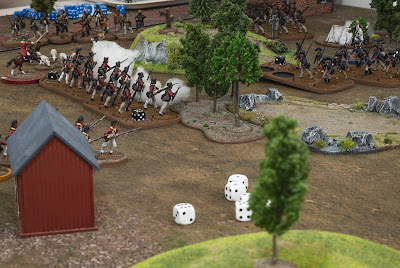
My partner rather use dice to count shock, so I've made some bases for them, so they are visually more integrated into the table and also to avoid rolling or picking them by accident. We use small black dice.

For counters I have similar solution, based white small dices that be attached to the movement trays. For example to count the 3 HE rounds in the British 2" mortar or the 3 fuel charges for flamethrowers.

Then I use "conventional" MDF or acrylic tokens for different status like: Tactical Stance, Overwatch, Broken, Pinned, -1 level for leaders.

For smoke grenades / shells I use 3" MDF bases. 

Terrain

Terrain is one of the elements that in my humble opinion can make or break a game. While it's true one can use anything available like books or cans, accurate high quality terrain can give an immersion that nothing else can.

The base for me it's a good mat. I personally use the mouse pads by Deep Cut as they are resistance and their weight allows me to keep a flat surface at all times.

Entrenchments, tank barriers and wire fences. At least a minefield is also required.

Trees and hedges are really useful in most settings. 

Unlike other historical settings, fencing and obstacles are vital for a modern war scenario as weapons have really long ranges and soldiers need some cover to survive.

Forces

Infantry. Infantry is the base of all force. Basically just follow whatever is explicitly stated in the Pint Sized campaign list. 

Infantry supports. I believe the basic infantry supports for all forces should be a RTO/Forward observer, medic, Sniper, a flamethrower team, an engineer team and a tripod MG.

Vehicles. A couple of the most common tanks a a staple for almost all forces (except maybe Japanese). Soft / Armored Transports are not really needed in most scenarios, so I don't think they should be prioritized. 

Artillery. I find that having at least an AT gun as a support is a must have for any force. Infantry guns can add some interesting options, but close fire support can also be simulated with an off-the-table medium mortar. 


Long journey to a “complete” game of CoC

It has taken me a while to get enough elements to prepare a “complete” Chain of Command game. Obviously the adjective “complete” may have different meanings to many people. In my case, I consider a “complete” game when I’m able to play a TooFatLardies Pint Sized Campaign. So, when I have enough stuff to deploy two base platoons plus diverse supports in addition to a properly made terrain and attractive game markers that cover most common situations.

Spring-Winter 2019

The tortuous path began three years ago, in spring 2019. At that time I decided to immerse myself in historical figure wargaming as an excuse to spent less time in front of screens. Back then, my knowledge of the hobby was extremely limited. I had only played some Fantasy Warhammer in late 1990s. Few years ago I had discovered Bolt Action WW2 models in a Stockholm store, Science Fiction Bokhandeln. My natural first step was to order their “Band of Brothers” starter set. 

Unfortunately due to courier issues it took a while to arrive. Enough for me to take advantage of Warlord Games sprue sale and purchase way too many sprues for almost all possible WW2 theaters. Big mistake. I first built a US Paratrooper and a German Grenadier forces.

My base German Grenadier platoon (WIP).

To get to know the rules, I watched multiple videos of gameplays in YouTube. One channel stood out over the rest, Tactical CP. There I discovered Chain of Command. After watching a couple videos I was amazed of how much more accurate it was in depicting modern warfare. While Bolt Action felt like a competition oriented arcade game with a WW2 “skin”, CoC felt like a proper simulation of WW2.

Making the rule-set switch was not easy. It took me some time to convince my main gaming partner. Finally they conceded, so I started slowly adapting my Bolt Action forces to depict the realistic platoon order of battle of Chain of Command. In addition I rebased them from Warlord Games plastic 25mm bases to 24mm metal washers -to give them more heft and be able to have a magnetized storage-. 

After a couple of games Grenadiers vs US Paratroopers, I realized that the disparity of forces made it hard for my partner to learn the rules. That’s why I created a British force, as it’s structurally closer to the German Grenadier platoon. At that time I played in a 4x4 feet table as I lacked anything better, so the fights felt quite close quarters.

Spring ‘21

At the beginning of 2020 with the Covid-19 craze I was forced to take a break from wargaming. Fast forward to the first months of 2021 I managed to go back on the wargaming saddle. At that time I bought a couple of magnificent gaming mats from Deep Cut Studios and a 6x4 feet table. That way I would be able to play the games with enough space. 

The bigger table felt quite empty so I expanded my collection of scarce terrain acquiring new trees, also buildings from Sarissa and Charlie Foxtrot, and even some small stuff from Warbases. Warbases has excellent “1-man movement trays” that are perfect to highlight the junior and senior leaders. Leaders are the base of the Chain of Command -and most TFL- rules, so I found it imperative to have a way to make them stand out on the field. 

At that time I found out that setting small teams and MG teams in a moving tray eases the game and allows us to identify and move them quickly on the table. Triangular 3-men bases for MGs and circular 3-men trays for bulkier supports like light mortars, finally a 2-men base for small teams. They are small enough to fit in most terrain, not affecting much the game. Rifle teams I deploy them individually as being the maneuver element they usually need to fit in tighter spaces.

Unfortunately in Summer 2021 I had to take another break from wargaming because of the birth of my first child. Parenting and work took all my time for many months. Finally in September 2022 I was able to stabilize my agenda and have some free time. 

My British late war platoon (WIP).

Fall ‘22

This fall I tried to make out for the lost time by purchasing a series of 3D printed buildings by Patrick Miniatures and few more trees. I also crafted multiple supports I had on storage (engineer 3-men teams, AT guns, etc.).

Hopefully soon I’ll be finally able to complete my project to be able to play the TooFatLardies Operation Martlet Pint Sized Campaign. I’m now waiting for the arrival of few more tanks and support teams from Warlord Games as well as some extra hedges and fields I ordered from Etsy.

Future plans

While I consider my base forces soon to be finished, there are plenty of updates that I have planned for them. The addition of new support vehicles like the Stuart light tank and additional artillery guns. Add extras to my German platoon to be able to field Volksgrenadier squads. 

Another addition that would be much needed is an AA vehicle or gun for the Germans to play the last scenario of 02 Hundred Hours. 

SITREP: Sunday update #2

Last week I worked on some of my Northern French buildings and a new group of AWI Continental skirmishers for Sharp Practice 2.

On Friday I received a package from Fantasy Welt that I had just ordered last Saturday. Kudos for their celerity. It included Perry's amazing American Farm House and Rubicon's Utility & Light pole set. I also ordered a batch of 6 extra 8cm tall trees. 

The two Northern France buildings I worked on where from Patrick Miniatures. I painted them in a way they can also be used for my Llardona 1808 long time Peninsular War SP2 project.

Work in progress

My AWI Continental Skirmishers were a pack of North Star figures for Muskets & Tomahawks II. To be precise the French & Indian War French Canadian Militia 1 6 figure set. They look amazing. Really rugged woodsman style. My only criticism would be that I had to work hard to remove the cast marks from the lower legs. It took longer than cleaning most plastic figures.

I've also started researching a bit the possibilities for next year's big Winter War / Eastern Front project for Chain of Command. I found it's better for me to use a Pint Sized Campaign to guide me. That way I can figure out what miniatures and terrain to buy / make. As there was no official campaign for the war in Finland, I found Winter of No Surrender which at first sight seems quite well documented and useful. To complement it I also purchased Storming the Citadel an official PSC from the TooFatLardies. That allowed me to realize that I will need plenty of Russians and Finns as both use four squad platoons. In my shame pile of lead I have plenty of Soviet Russians from Warlord Games, so should be quite enough, but only a limited amount of Finns (by the same maker). In addition, seems that Warlord Games Finn squads lack a LMG, so I'll have to figure out another source or a conversion to get some. 

SITREP: Sunday update #1

Last week I worked on magnetizing part of my miniatures and terrain. 

As most of my stuff is set on metallic fender washers, and I'm not to keen on buying tons of small magnets and attach them to each and every base, I've decided to buy magnetic sheets from Supermagnete and attached them at the bottom of my plastic storage boxes. 

Some of my bigger miniatures were set on 40 or 60mm plastic bases, those have been rebased into wider metallic fender washers.

I also have created a couple of artillery markers for Sharp Practice 2 inspired by John Emmett's ones. They are used to mark the remaining canister shoots. 3 by default. 

In addition I created a barricade for the same rules. 


Artillery counters.

On Tuesday I received a package from Stronghold Terrain that includes all I need to finally finish my Sharp Practice 2 American War of Independence forces. For one side I'll use a Perry Miniatures' British AWI box to create the remaining groups of both sides. I like the idea of mixing some Continental soldiers with dyed British uniforms for my state troops and militias. To add a bit more variety to my Continental skirmishers I've purchased a Canadian Militia pack made by Northstar for Muskets & Tomahawk.

In the future I'm planning to purchase new commanders for both sides, as I'm using 28mm oversized Warlord Games one that break the nice proportions of my mostly Perry's force. 

On the terrain front I've been working on a couple of buildings for my Northern France WW2 village. I prepared them in the same way as my Catalan Napoleonic Peninsular War buildings -with a layer of wood filler and patches of sand- and painted them in faded yellows. The idea is to be able to use them both for WW2 Northern France and Italy as well as Napoleonic Mediterranean settings. 

Baptism by fire - 02 Hundred Hours

Last evening we took 02 Hundred Hours for a first test run. Created by Graham Davey of Grey for Now, it's a fast paced small skirmish miniature wargame based on WW2 night raids. 


Our first game was quite an experience. I must confess that it felt quite different than what I had expected. I thought it would be a close sibling of Test of Honour, but to my surprise it's more like a distant cousin and hence it feels quite different. The new dice mechanics combined with the inclusion of two well differentiated sides (attackers vs defenders-guards), gives it quite a unique taste. 

While it’s a small-scale skirmish that does not require an excessive investment to bring to the table, it’s not the easiest game to pick up. I would not recommend for beginners as the stealth / detection mechanics add up to the usual move / fight mechanics. Said that, those who like me, already played Test of Honour will have an easier acclimation to the system.

It features a token (or pebbles like in our case) activation system. They are randomly picked from a bag and distributed amount both forces, this adds a certain level of uncertainty.  In addition, this was a great excuse to recover a German dice bag from Warlord Games Bolt Action that had fallen into oblivion.

The starter set includes a good amount of beautifully sculpted miniatures of German guards and SAS operatives by Wargames Atlantic. If someone already owns a good bunch of WW2 figures it's possible to purchase the rules, tokens, cards and dice on their own. I personally believe that at £49.60 the starter set is really worth it.

All in all, it's an inexpensive fun quick game with a nice WW2 flavor. I believe the rules can be used pretty much untouched in other modern conflicts that involve special operations stealth raids.


Back in the saddle & Recap '21

Much has happened in the last year and work and the arrival of a new family member took priority over my hobbies. Finally my life has stabilized again so I can again dedicate some time to one of my favorite and most fulfilling hobbies, historical miniature wargaming. 

I plan to retake my Western European WW2 village project and my Peninsular War Llardona 1808 one. 

Looking at the short term future I'm especially curious about the advent of a 02 Hundred Hours, a new small skirmish game about small night commando raids during World War 2. It was developed by Graham Davey (Grey for Now), one of the main developers of the successful Test of Honour. It's stealth mechanics makes it quite different than any other proposition I've seen on the market.

Another title I'm keeping under watch is Dead Man's Hand by Great Escape Games. It's a simple small skirmish game set in the old Far West, a theme my gaming partner is especially interested in. 

My final wargaming game count for 2021 was:

14x Test of Honour

11x Sharp Practice 2

6x Chain of Command 

All in all, I consider it a decent and variated amount. 

Llardona 1808

To give some character to my ongoing Peninsular War project I decided to call it "Llardona 1808", strongly inspired by the great Sidney Roundwood's Laarden 1688.

The focus of my project will be to reproduce a stereotypical Catalan small village and the clashes around it. The creation of a fictional location gives me a certain amount of creative freedom on the narratives of future games. 

The name is created through the union of the Catalan word "llard" (which unsurprisingly stands for lard) and the toponymic suffix "-ona" which can be found in different cities and villages around Catalonia (Barcelona, Cardona, Girona, Solsona, etc.). 

As in most historical gaming related projects, I try to research as much as possible to be as accurate as I possibly can but at the same time allowing some leeway for extra kicks and giggles. Bear in mind that I engage this project as an excuse to learn about the conflict and the era, which means that I'm obviously not an expert and I most certainly will make plenty of mistakes. 

To gain a broad knowledge on the conflict I decided to delve myself into the book series A History of the Peninsular War by Sir Charles Oman, written at the end of the 19th century. I found it to be close enough to the period to have plenty of contemporary sources, but distant enough to allow a colder analysis. And well, it’s engaging and fun to read.

Going Peninsular

As it's said "plans don't survive contact with the enemy". And my 2021 plans did not survive the first contact with my playmate. After serious consideration we decided that we'll focus the next months on the Napoleonic era. Specifically the Peninsular War. 

The Peninsular War has always been a conflict I wanted to learn more about. Especially since I've done plenty of trips around the Iberian Peninsula and its landscapes are quite dear to me. From the wet cold North to the more arid South. 

We determined that the system that seems more suitable to simulate the guerrilla warfare that occurred there is TooFatLardies Sharp Practice 2

Guerra del Francès

As the conflict is quite broad, I've decided to start focusing in the nasty skirmishes and battles in the fierce Principality of Catalonia. What is commonly known as "La Guerra del Francès" (in Catalan). The conflict in Catalonia can even be considered its own autonomous conflict. While it has some links to the Peninsular War, there are many features exclusive to it.

To understand the importance of Catalonia, one must learn how Napoleon ordered its annexation to the metropolitan France, to keep it under his personal power, unlike the rest of the Peninsula that was given to his brother Joseph Bonaparte. 

As the well known British historian Charles Oman said: "Far more than any other section of the Spanish nation do the Catalans deserve credit for their unswerving patriotism. Nowhere else was the war maintained with such resolution.". "There was no recognized leader, no general of repute, to head the rising of the province. Yet the attack on the invaders was delivered with a fierceness and a persistent energy that was paralleled in no other quarter of the Peninsula. For six years marshal after marshal ravaged the Catalan valleys, sacked the towns, scattered the provincial levies. But not for one moment did the resistance slacken; the invaders could never control a foot of ground beyond the narrow space that was swept by the cannon of their strongholds. The spirit of the race was as unbroken in 1813 as in 1808, and their untiring bands still held out in the hills, ready to strike at the enemy when the least chance was offered. Other provinces had equal or greater advantages than Catalonia for protracted resistance: Biscay, the Asturias, and Galicia were as rugged, Andalusia far more populous, Valencia more fertile and wealthy. But in none of these was the struggle carried on with such a combination of energy and persistence as in the Catalan hills.

First forces

To keep the first investment reasonable and versatile I'm planning to acquire enough miniatures to develop a French Light Column (as stated in the rulebook) manned by Voltigeurs and Dragoons. On the "allied" side, I'm pondering adding a Light Column that includes light infantry and riflemen, as well as some Catalan "Somatent" Skirmishers. 

These forces will allow me to represent the clashes in the late war, from 1812 to 1813. The idea is to keep expanding them with new Catalan units like the Miquelets, as well as Spanish regulars and even Royal Marines that conducted raids over the coast. 

In the black powder era there's few miniatures producers that can beat Perry Miniatures, so I'm planning to build the bulk of the forces with their amazing figures. 

Terrain

Battleground is key for any miniature recreation and I have set my eyes on the Charlie Foxtrot Pantile collection as In my humble opinion is the one that represents more faithfully the Southern European / Mediterranean buildings.  Unfortunately the consequences of Brexit and all its inconveniences may force me to simply purchase a token order. 

Chain of Command comeback

To get ready for my Chain of Command comeback I decided to choose a balanced force of both British and German troops. The idea is to be able to practice common basic tactics like fire & maneuver leaps. 

When we have more confidence in the rules I want to delve into one of the Too Fat Lardies pint sized campaigns. The option that better suits the forces and setting seems to be  Operation Martlet. That one simulates the historical fight between the British 49th Division and the 12th Waffen-SS division "Hitlerjugend" around the Rauray Spur. 

Depending on how successful this campaign is, I may mull adventuring into its sequel the Scottish Corridor.

Figures

At this moment I'm working to finish a line infantry platoon both for the British and the German (Wehrmacht Heer). 

As mentioned, the campaign is designed for a Waffen-SS Panzergrenadier platoon -the infantry that followed the panzer units be it on trucks, half-tracks or even riding on the tanks-, but it can really be played with Heer Panzergrenadiers as they are pretty much organized and equipped in the same way (with the added bonus of being less controversial* to certain people). Said that, immersion and realism is always a plus, so time permitting I may work on some of my Warlord Waffen-SS figures. 

*For those unaware, the Waffen-SS was the "private" military branch of the NS-DAP party. Initially composed of nazi fanatics and careerists from Germanic nations, it later became an international multi-cultural but politically-driven volunteer force. At the very end it even included conscripts. Some of its units were infamously involved in numerous war-crimes.

Vehicles

In my collection I have already a ubiquitous Panzer IV, a Panzer VIA Tiger and a British Sherman Firefly but I would like to acquire a nice British tank like a Warlord Sherman V,  Churchill or a Cromwell.

In addition I also have in my "to do" list to build a Bren carrier. 

Terrain

My main goal terrain-wise is to be able to gather enough buildings to be able to recreate a countryside farm or a tiny village. If possible with buildings that could be at the same time representative of western Europe - especially France's Atlantic Coast and Benelux- and America in the last 2-3 centuries. 

A key building for every town in Western Europe is the local church. So far I have been looking for a nice small church / chapel without much success. 

As the campaign also involves countryside terrains, I'd like to acquire a farm building with at least one of its typical side buildings: barn and stables. I have found different possibilities:

Sarissa La Belle Alliance

Charlie Foxtrot Farmhouse 

- Charlie Foxtrot Dormer House 

As a side buildings:

- Charlie foxtrot outside wc

- Charlie Foxtrot Workshop / store to represent a barn.

Although those don't represent properly the most common buildings in Northern France that were made of stone walls (no plaster). 

Finally some modern industrial buildings to represent the outskirts of a Western European town. And that could also be used to represent Eastern factories. 

- Sarissa factory office 

- Sarissa factory unit 2

On support terrain I would like to find a solution for minefields as well as finish some of my resin fortifications.

Last but not least, some scatter terrain:

Charlie foxtrot memorial needle and graveyard set.

Markers

Marker-wise I have been pondering how to create a nice marker to display the injured status.

In addition I'm also thinking on how to build nice unique jump-off markers for the British forces, as at this moment I use parachuted containers that suit airborne troops better. 

Is historical wargaming dying out?

Today while painting some miniatures and preparing some terrain I was listening to one of the episodes of the Too Fat Lardies' podcast -Oddcast 35-. They brought to my attention a video from Little Wars TV concerning the apparent death of historical wargaming.  

As someone in his mid-thirties -I'm 35-, I thought it would be interesting to bring my point-of-view to the debate table that is the Internet. As in the podcast, I think it's useful if I explain a bit my background in the hobby previous to give my particular opinion on the subject.

Catholic Miniatures

My first experience with miniatures -not wargaming- is kind of an odd one, I started with what could be called religious miniatures. My father was a deeply catholic man who every Christmas religiously built a nativity scene at home. The traditional one usually involves the actual nativity scene, the three magi kings in their camels and maybe adds some extras like animals and few village buildings around in around the 1:32 to 2:48 scale. 

As a fun fact, I discovered that in countries like Spain you can find huge markets with plenty of figures, terrain, animals, etc. to build nativity scenes. So you could say that most people there is into miniatures. 

When I was old enough, around 5, I used to help him, and expanded a bit the scene to include roman soldiers, markets, rivers, etc. To the point that at around 8 my father send me to a Catholic association that every year had a display of "nativity scenes" that was more like an ancient times diorama scenes including Roman military forces, plenty of buildings, fishermen in small boats in lakes, etc. Everything was build from scratch using woods, plaster, ceramics, etc.

A photo of a Christmas traditional miniature stand I took in one of my recent visits to Spain

WW2 Dioramas

One day while going to a big warehouse to buy some supplies, I happened to see some small plastic WW2 soldiers and vehicles -I guess around 1:72 scale-, and I couldn't resist. Since I discovered the Lucasarts Indiana Jones PC games when I was 5 I had been obsessed with WW2 and military history.  So instead of buying some extra paint bottles, I bought a couple of models and built my first WW2 diorama (a D-Day landing craft with soldiers exiting it). 

Since then I occasionally bought and build some military models from fighter planes to tanks as soon as I managed to save enough money for it. My allowance was meager, and as one can imagine, like any small kid I also had other -completely common- interests (like reading WW2 books about Waffen-SS and such, and play WW2 PC games). 

Into wargaming miniatures

When I was already a teenager, I started visiting a gaming store where I had Lord of the Rings roleplaying game sessions with my high-school gang. I felt in love with the Games Workshop miniatures sold there, and with my of one good friends we started building a small Warhammer Fantasy army. At that time I couldn't even imagine that historical wargaming existed, so my approach was to simply buy the most historical realistic army I could find in Warhammer. I choose the Empire, because it had a strong Germanic pike & shot feeling, and I enjoyed pushing the trays of infantry pike-men and shooting my artillery guns. 

Due to the lack of contenders to play with, my interest faded and I focused more on PC military simulation. 

When I joined the military as a professional soldier, I had to abandon everything I had at my parents home so I completely forgot about it. To this day I have no idea where my Warhammer Fantasy figures ended.

Rediscovering the hobby

Many years later, In 2015, I was visiting Stockholm's old town (Gamla Stan) and I happened to found a huge hobby-store. In the upper level they had a huge collection of Games Workshop stuff, that I felt naturally attracted to. Looking around I found a few odd boxes in a dark corner. They were something different. They were WW2 miniatures from Warlord Games. Like in my childhood days I could simply not resist. 

At that time I had no plans to play any wargames, but I really couldn't stop myself , so I decided to buy a plastic tank. The problem is that I could not decide between a British Firefly or its great opponent the Panzer VIA Tiger. So my wonderful wife simply offered to buy the other one. That's how I started my WW2 wargame miniature collection. Every trip we did to Stockholm I purchased a new vehicle. 

One day while talking to some of my PC military simulation friends online, I was told about a WW2 board game called Memoir 44. I purchased right away and convinced my wife to play some games with me. She loved it and we played plenty of games. 

We enjoyed it so much that I dusted off some of the Warlord's plastics I had on display and asked her if she would be willing to take the next step. She agreed. And we purchased the Bolt Action starting kit -and some extras-. 

And since then we have been playing different historical wargames (especially Test of Honour, Bolt Action and Chain of Command). Here in Finland wargaming clubs are rare and mostly focus on fantasy games like those from Games Workshop, so our flat has become our own private historical wargame club. 

My opinion

So, as seen in my lengthy story I've always been a military history buff, and with minimal exposure to miniature historical gaming I have always gravitated towards it one way or another. At the same rate I visited most WW2 museums and battlefields in Western Europe and the Nordics, and purchased tons of books, I have always been interested in miniatures and dioramas too. Just that I didn't even realize historical miniature wargaming was a thing until few years ago. 

I may be an odd case, but if when I was a kid I had known I could play tabletop wargames with WW2 historical figures I would have done it right away. And I know of plenty of kids interested in military history that would also follow that path. That's why I really don't buy into the belief that all youngsters tend to gravitate towards flashy fantasy and sci-fi games. 

There's also the argument that "PC killed the radi... -sorry- tabletop star". Which again I find it unfounded. Actually one of the reasons why I'm so invested in historical wargaming is that it allows me to take a break from a day in front of a computer screen. And bear in mind that I lead a PC military simulation community and participate in two events a week with them, so I'm not precisely a luddite. 

I don't even think that you need a huge social experience where you have to join a club and travel to plenty of places to enjoy the hobby -although I'm sure it's fun too-. As I said, I mostly play with my wife at home -it's a pandemic-proof system-. And thanks to Internet you can share experiences with people from around the globe.

Availability of figures and terrain has become a bit of an issue for me, as I live in a country with not much following. But again, thanks to the Internet I managed to purchase stuff from all over the World -especially from Blighty-. Although it's certainly pricey to import from abroad.

In conclusion, my opinion is that historical wargaming is not dying at all. But it has a huge issue, simply put: it lacks visibility. I have the perception that many people that could be interested and thrive in the hobby don't even know it exists.


Plans for 2021

 After my comeback I've been mulling what's the best way to start steady. As it's usually said, it's better to start small and simple and then transition to more complexity. 

Test of Honour: Sengoku

My first goal will be to rediscover Test of Honour, and its brand new expansion: Sengoku. I want to dedicate the year's first months to work on my Japanese backlog and relearn the Test of Honour rules as well as immerse myself in the new expansion book. Probably adding a few new figures and terrain to the collection -to avoid having to use western placeholders-. 

As its title hints, the expansion is about the Sengoku period (15th-to-17th century) when Japan faced near-constant civil war. It gives special rules for the clans of the era, new weapons and mechanics, as well as a bunch of new thematic scenarios.


Rethinking terrain

Now that I had a bit of idle time to think properly about my wargame needs and manias, I realize that I may have gone too far with my granular approach. Having ten thousand different items (tress, barrels, bushes, small buildings, etc.) to compose each battleground forces me too much time when preparing a game. So my goal will be to build small based dioramas that can be used as "scatter" terrain. 

Back to the breach

When I achieve a good amount of proficiency over Test of Honour, my plan is to work a bit on my insanely big backlog of WW2 stuff. Especially focusing on terrain and supports for TooFatLardies Chain of Command

I've been a "huge fan" of WW2 history since I was a kid. I blame Indiana Jones PC games that I discovered at the tender age of 5-7 years old. So naturally they have been one of my main interests in wargaming and built a -way too- big stock of plastics and metals. 

To be precise, my goal for this summer will be to work on the -overly done- Western front in 1944, from the Calvados Coast to the Ardennes forest. Especially focusing on the operation Overlord, operation Market Garden and the Battle of the Bulge.

In Fall I plan to evolve to the Eastern front with the addition of a Soviet platoon, some buildings, and maybe even some Finns.


Exploring other systems

As history is not only about Japan and WW2 -even if it may sometimes seem so-, I want to explore a couple of small skirmish systems like Mortal Gods and Baron's War. I personally like small story-driven skirmishes' games because it allows me to have shift games in small spaces without having to use many overcomplicated rules -nor buy & paint a huge amount of figures-. Both could be considered spin-offs of Test of Honour. 

Mortal Gods. Is a close derivative of Test of Honour set in ancient classical times. Perfect to scratch the itch of Mediterranean Greek fights. I really hope they expand to include Rome and the Gauls. 

Baron's War. It's an unreleased skirmish wargame that seems to build upon the Test of Honour base to achieve a more elaborated game. 

Another large skirmish system I'm considering is Sharp Practice. Has been on my sights for quite a while now, and it would allow fast pick-up games due to the unit bases it uses. 


Back to wargaming

After almost a year hiatus -2020 was a hard year- I'm now able to dedicate some time to one of my passions, wargaming. This blog will serve as a testimony of my game sessions and other hobby related information. 


Back in the saddle

Brief update.  After a 4-month break due to health and work issues, I'm finally back in the saddle. The silver lining of such a lengthy ...